A high pool pH reading is easy to overcorrect. You see a number above the recommended range, reach for the first acid product you can find, and hope the water settles by the time anyone wants to swim. That can turn one routine adjustment into a second problem, because pH, total alkalinity, chlorine performance, water comfort, and pool surfaces all influence one another.
The calm way to lower pH in a pool is to confirm the reading, understand whether it is a small drift or part of a bigger water-balance problem, use a pool-specific reducer exactly as directed for the actual pool volume, keep water circulating, and retest before adding more. It is not glamorous, but it is much cheaper than correcting a wild swing in the other direction.
This guide focuses on a residential pool with a genuinely high pH reading. It does not replace a product label, local rules, or qualified help when water is cloudy, equipment is not moving water normally, or chemicals may have been mixed incorrectly. If the pool is causing burning eyes, coughing, severe irritation, or a strong chemical smell, keep swimmers out while you identify the cause instead of trying to make the water look normal quickly.
The short answer: lower pH in small, measured steps
For most backyard pools, the practical answer is a pool-specific pH decreaser or acid product used according to its label. The exact product, pool finish, water volume, total alkalinity, and starting pH all affect the amount and method. That is why there is no responsible one-size-fits-all scoop or cup count.
The Centers for Disease Control and Prevention recommends a pH range of 7.0 to 7.8 for home pools. It also notes that higher pH makes chlorine less effective, while pH below 7.0 can be corrosive and uncomfortable. CDC home-pool testing guidance is a useful starting point, but your own equipment and product instructions still matter.
The goal is not to chase one perfect number all afternoon. Bring a confirmed high reading back toward the range recommended for your pool, then give the water time to mix before judging the next step. A measured correction protects swimmers, plumbing, plaster or liner surfaces, and your wallet.
Start by confirming the reading
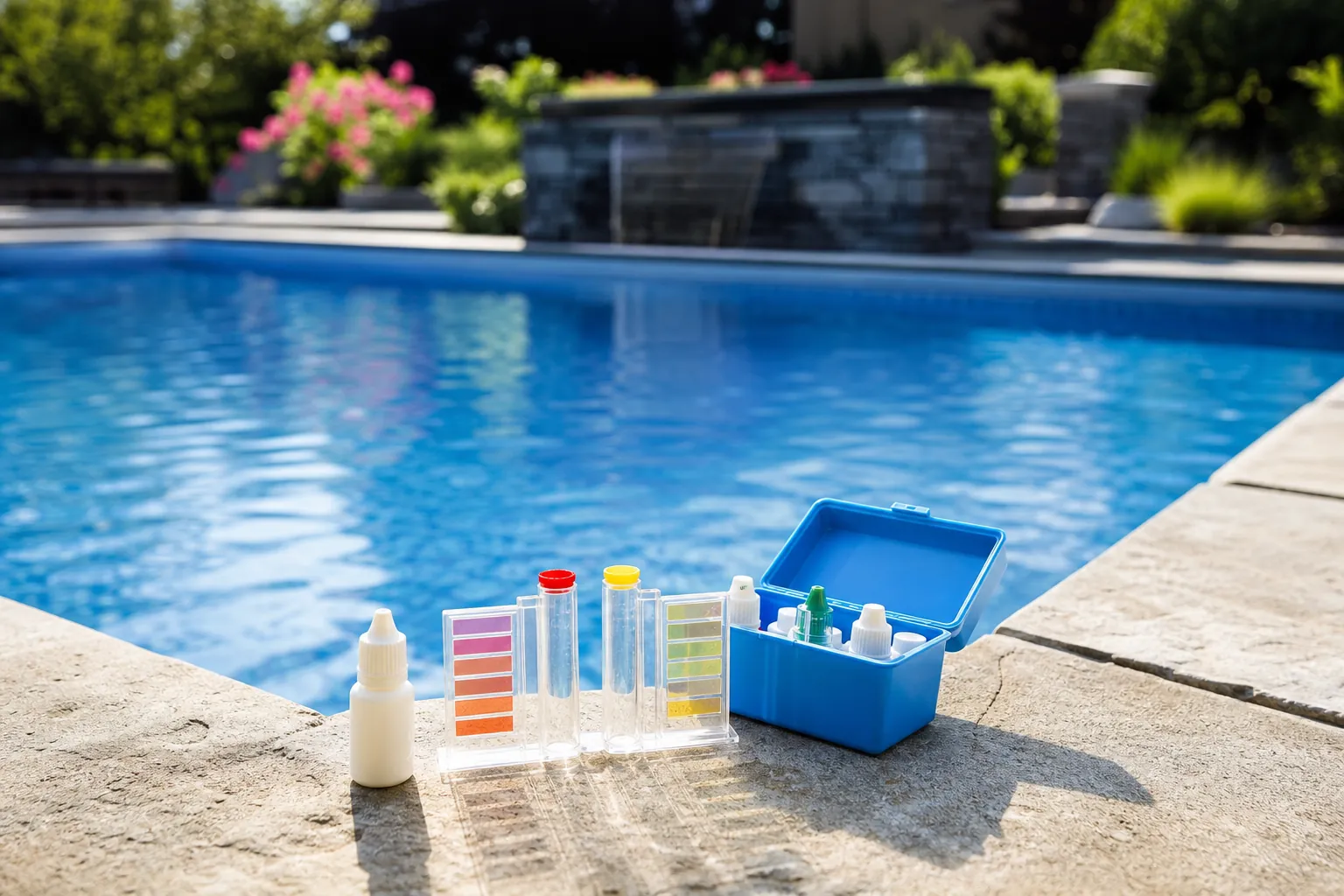
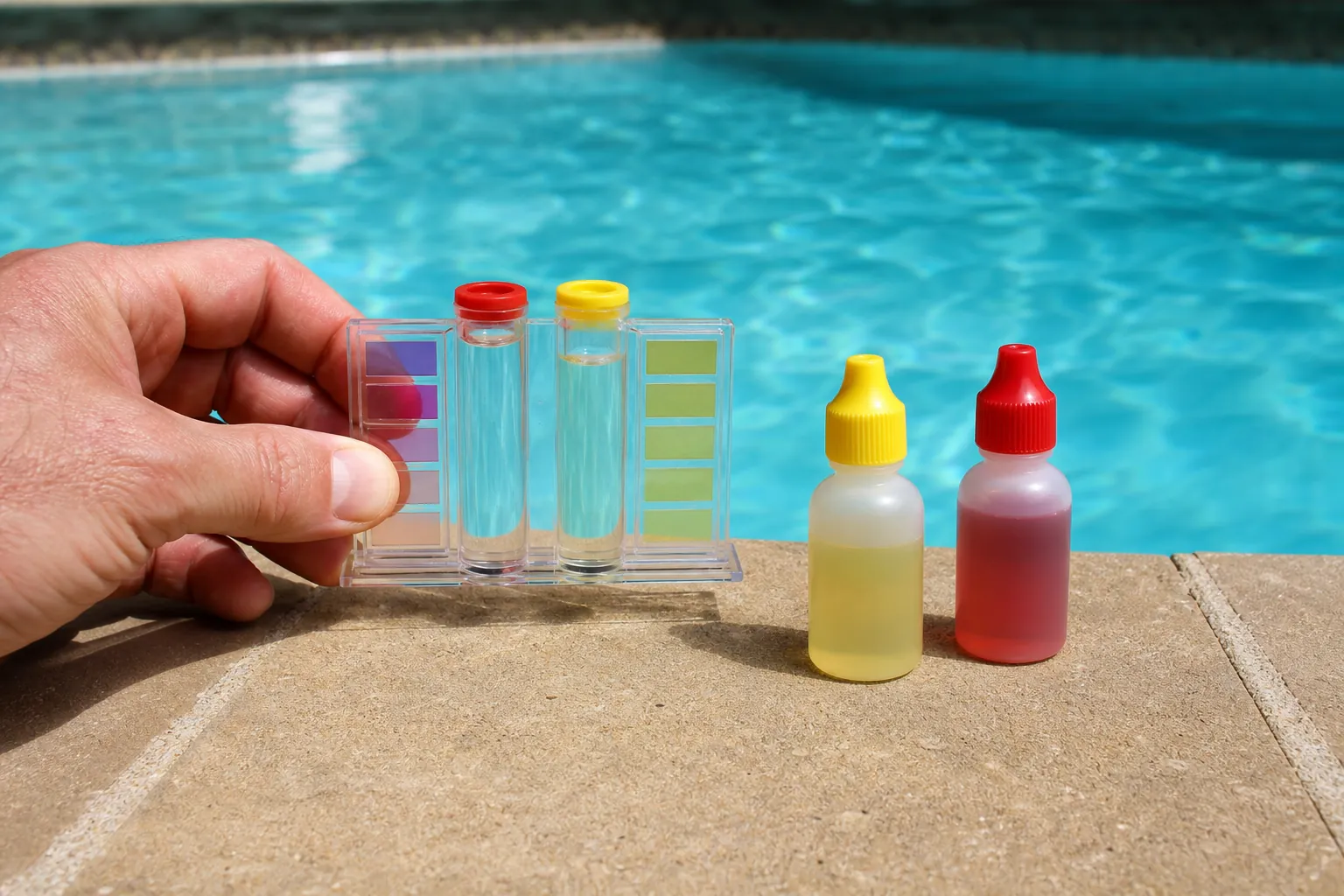
Do not make a large change from one rushed strip. Test from elbow depth, away from the skimmer and return jets, then follow the timing instructions on the kit exactly. Surface water, a sample taken beside a return, old strips, sun-bleached reagent, and a color read too late can all give a misleading result.
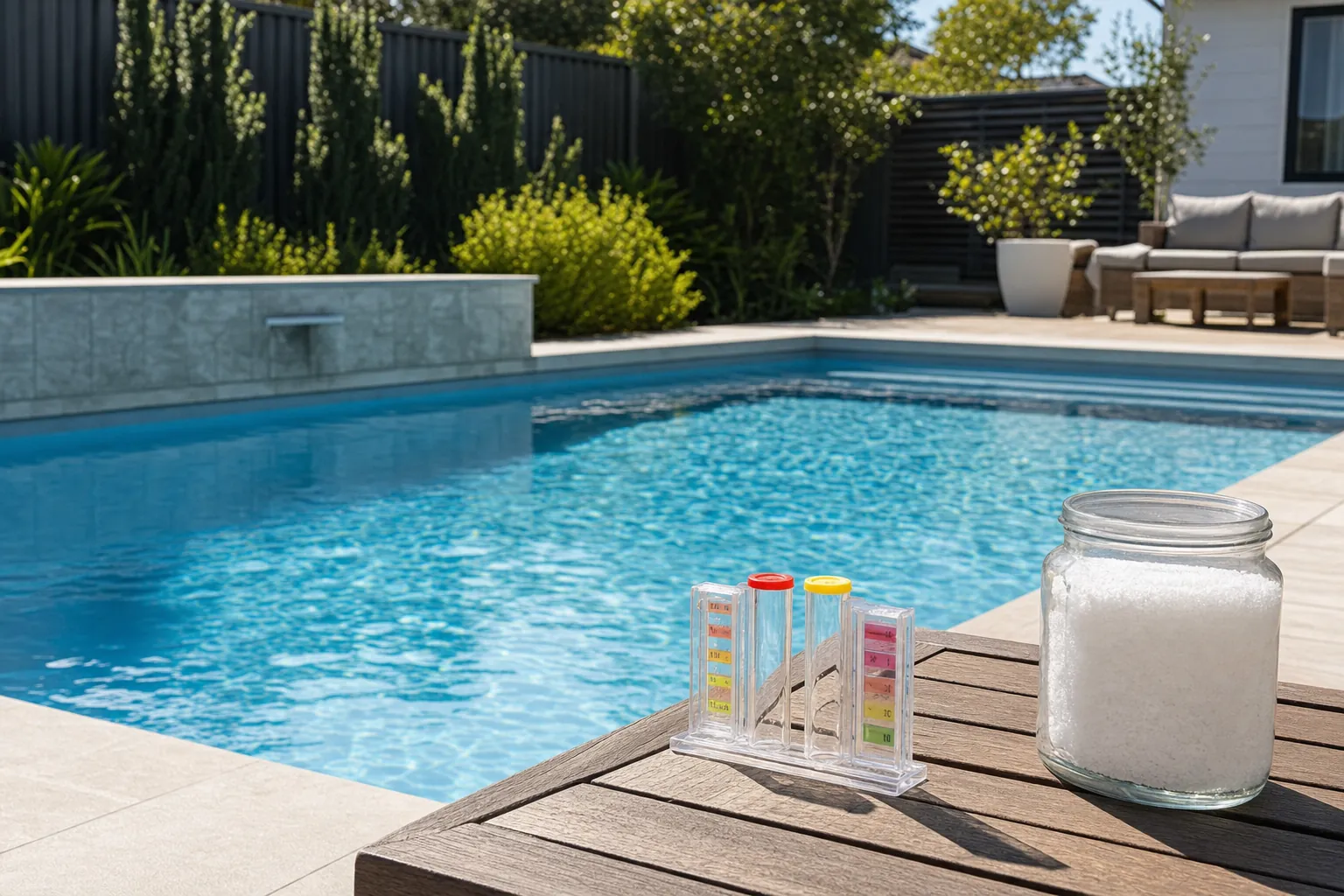
If the number is surprising, test a second sample before adding anything. A quality liquid drop kit is useful when you need a closer reading, especially before a major adjustment. The CDC recommends checking chlorine and pH routinely, and it specifically warns that very high chlorine can affect some DPD tests. When the test result and what you see in the pool do not agree, slow down rather than assuming the water needs another product.
Test total alkalinity at the same time if your kit allows it. Alkalinity helps resist sudden pH movement, so a pool that keeps rising in pH can be a balance issue rather than a one-time correction. Aquastaser's guide to raising pool alkalinity safely explains why the two readings are connected and why it is worth writing them down together.

Know what a high pH reading can mean
High pH means the water is more alkaline. In a pool, that can make sanitizer less effective and can contribute to scale, cloudy water, or irritation when the rest of the water balance is also off. A high reading does not automatically explain every uncomfortable swim or every cloudy day. It is one useful clue, not a complete diagnosis.
Look for the surrounding context. Did you recently add an alkalinity increaser, fill the pool with fresh water, run a saltwater chlorine generator for longer than usual, leave the water uncovered through hot weather, or add several products close together? Did the pool get busy, collect debris, or show a change in circulation? A short note about what changed often explains more than an isolated number.
If pH keeps drifting up after careful corrections, the cause may be persistent rather than accidental. Aeration, source water, a high alkalinity level, scaling, equipment settings, or an inconsistent test routine can all be part of the picture. Repeatedly adding reducer without finding the pattern is how routine pool care becomes a chemistry hobby nobody asked for.
Before adding a pH reducer, check the pool and the product
Read the product label before opening the container. Confirm that it is intended to lower pool pH, that you understand the safety directions, and that the dose guidance matches your pool's actual volume. Do not guess the gallons from the shape of the pool or borrow a dose from a neighbor with different equipment and water.
Keep swimmers out while you make an adjustment. Wear the protective equipment the product label calls for, work in fresh air, keep the container closed until you are ready to use it, and never mix pool chemicals or pour one product into another container. Use only a clean, dry scoop or measuring tool when the product calls for one. Pool chemicals are useful when handled as directed and spectacularly unhelpful when treated like pantry ingredients.
Check that the pump and filter are operating normally before you add anything. A pH adjustment needs circulation to distribute through the pool. If flow is weak, a filter is overdue for cleaning, or the pump is not moving water consistently, correct that mechanical issue first or ask for help. Chemical corrections cannot make up for water that is not actually circulating.

How to lower pH in a pool without overshooting
First, calculate the pool volume as accurately as you can and use the product's directions for that volume and your starting pH. If the label offers a range, stay conservative for the first addition. It is far easier to make one additional small correction than to lift a low pH reading back up after an oversized dose.
With the pump running, add the product only in the manner the label specifies. Different products have different application instructions, so do not assume that a dry granular reducer and a liquid acid should be handled the same way. Avoid pouring product into the skimmer unless the label and your equipment guidance specifically tell you to do so.
Let the water circulate for the stated time, then retest from a fresh sample. Do not judge the correction by one sample taken from the same area where product was added. Check pH again, review alkalinity if you are making repeat adjustments, and only then decide whether the pool needs another small correction.
If the number drops farther than expected, stop adding reducer. Keep circulation going, keep swimmers out until the water is back in the appropriate operating range, and follow product or professional guidance for the next move. Trying to fix an overcorrection with a rapid stack of opposite products is a reliable way to lose track of what the water is doing.
Circulate, then retest from a fresh sample
Circulation is part of the correction, not an afterthought. The reducer needs time to distribute through the body of the pool, and a fresh reading tells you how the whole pool responded. If you retest too early or too close to the point of application, you may be measuring a concentrated pocket rather than the water your family will actually swim in.
While the water circulates, look at the basics: empty the skimmer basket, clear obvious debris, make sure return jets are moving water, and note whether filter pressure is normal for your pool. Those small checks help separate a one-time pH adjustment from a bigger water-care issue.
A short written log can save a lot of repetition. Record the date, pH, total alkalinity, free chlorine, weather, water temperature if available, and what product was used. You do not need a laboratory notebook. A few honest notes make the next test more useful and make it much easier for a pool professional to help if the water will not settle.

pH and alkalinity are connected, but they are not the same correction
pH describes how acidic or alkaline the water is at the moment. Total alkalinity describes the water's ability to resist pH change. They influence each other, which is why a stubborn pH problem often calls for a look at both numbers. They are not interchangeable, though, and they should not be corrected as if they are.
A pool with high pH and high total alkalinity may need a different plan from a pool with high pH and a normal alkalinity reading. The right sequence depends on the complete test, the pool surface, the sanitizer setup, and the product instructions. This is one reason a generic online dose chart is a poor substitute for testing your own water.
Outdoor pools with cyanuric acid, often called stabilizer, have another variable to consider. The Council for the Model Aquatic Health Code explains that cyanuric acid protects chlorine from sunlight but is not itself a disinfectant. Its cyanuric acid guidance is helpful context for why the same chlorine reading can behave differently from one pool to the next.
Common mistakes that make a high pH problem worse
Do not add a pH reducer simply because the water feels harsh or smells strongly of chlorine. A strong chemical smell can be linked to chloramines, and irritation can have several causes. Test free chlorine, total chlorine, pH, and water clarity before deciding which number actually needs attention. Aquastaser's chloramines guide explains why odor is a reason to test, not proof that the water needs more acid.
Do not make multiple large additions before you retest. One correction needs time to circulate. Adding more because the first dose has not changed a strip immediately can send pH too low, create a second balance problem, and make it impossible to know which action caused the swing.
Do not use household substitutes, improvised mixtures, or internet shortcuts. Choose pool-specific products, follow the current label, and keep products separate. The CDC's Healthy Swimming guidance consistently comes back to the same boring but effective foundation: appropriate testing, proper water treatment, and prevention before swimmers get in.
Do not ignore a high pH reading that keeps returning. A repeated pattern deserves a closer look at alkalinity, source water, circulation, product use, and equipment. One bottle of reducer can address a reading. It cannot diagnose why the pool keeps producing it.
When high pH is not a DIY problem
Bring in a qualified pool professional when the water is cloudy and the cause is unclear, pH keeps rebounding after measured corrections, the pool is scaling, equipment is leaking or losing flow, or you have already added several products without returning to stable water. Those are signs that the whole system needs a check, not that you need a bigger dose.
Treat a possible chemical mixing incident as urgent. Move away from the area, keep people and pets clear, and follow the emergency guidance on the product labels or contact local emergency services as appropriate. Do not try to neutralize unknown mixtures yourself. The same caution applies when anyone has difficulty breathing, severe eye pain, or worsening symptoms after chemical exposure.
If there has been fecal contamination or a serious illness concern, do not use a pH adjustment as the solution. That is a public-health response question, not ordinary water balance. Aquastaser's Cryptosporidium pool guide explains why a standard chlorine routine is not the whole answer after a diarrheal incident.
Keep the rest of the water picture in view
High pH is one part of a larger pool-care picture. Keep an eye on free chlorine, total chlorine, total alkalinity, stabilizer when your system uses it, calcium hardness, water clarity, filter condition, and flow. You do not need to correct every number every time you test. You do need to avoid treating one number as if it tells the whole story.
If chlorine is also high, tackle that situation first with a confirmed test and a measured plan. Aquastaser's high-chlorine pool guide covers the safer first steps. If free chlorine seems confusing, the free chlorine guide explains what that reading actually tells you.
The best maintenance routine is the one you can repeat without guesswork. Test on a sensible schedule, keep circulation and filtration healthy, make one intentional change at a time, and leave enough time to see what that change did. That routine is less dramatic than a pile of quick fixes, which is precisely why it works.
Where Aquastaser fits
Aquastaser is for homeowners who are tired of the regular chlorine routine and want a different day-to-day approach to pool water care. It uses hydrodynamic cavitation in the return line after filtration, so good circulation, clean filtration, practical plumbing access, and an honest look at the current water condition still matter.
It is not an emergency response for unsafe water, an alternative to testing, or a shortcut around a high-pH correction. Get the water stable first. Then, if the ordinary cycle of testing, dosing, correcting, and waiting is the thing you want to change, compare the fit for your pool on the chlorine-free pool system page or read how the Aquastaser system works.
Questions about pool size, return-line plumbing, pump flow, or an existing saltwater setup are worth asking before you buy. Aquastaser support can help you understand whether the system is a realistic fit for the pool you have, not the idealized pool in a product brochure.
Useful sources
Frequently asked questions
What should I add to lower pH in a pool?
Use a pool-specific pH reducer or acid product according to its current label. The right amount depends on the pool volume, starting pH, total alkalinity, pool surface, and product concentration. Test first, make a measured correction, circulate, and retest before adding more.
How quickly does pH reducer work in a pool?
It needs time to distribute through the water. Follow the product label for its circulation and retesting window, then take a fresh sample away from the skimmer and return jets. Do not add another dose just because the result has not changed immediately.
Can I swim after adding pH reducer?
Keep swimmers out until the product has circulated for the time stated on its label and you have confirmed that the pool is back in its appropriate operating range. If the water is cloudy, harsh, causing symptoms, or the reading is unclear, wait and get qualified guidance.
Why does my pool pH keep going up?
Repeated high pH can be connected to high alkalinity, aeration, fresh fill water, a saltwater chlorine generator, product use, or a testing issue. Track the readings and check circulation and filtration. If the pattern continues after careful corrections, have a qualified pool professional inspect the broader water balance and equipment.
Will lowering pH also lower alkalinity?
It can affect total alkalinity, which is why both readings should be checked when you are making repeat adjustments. They are connected but not interchangeable. Follow the product instructions and use the full test result rather than trying to correct both numbers from memory.