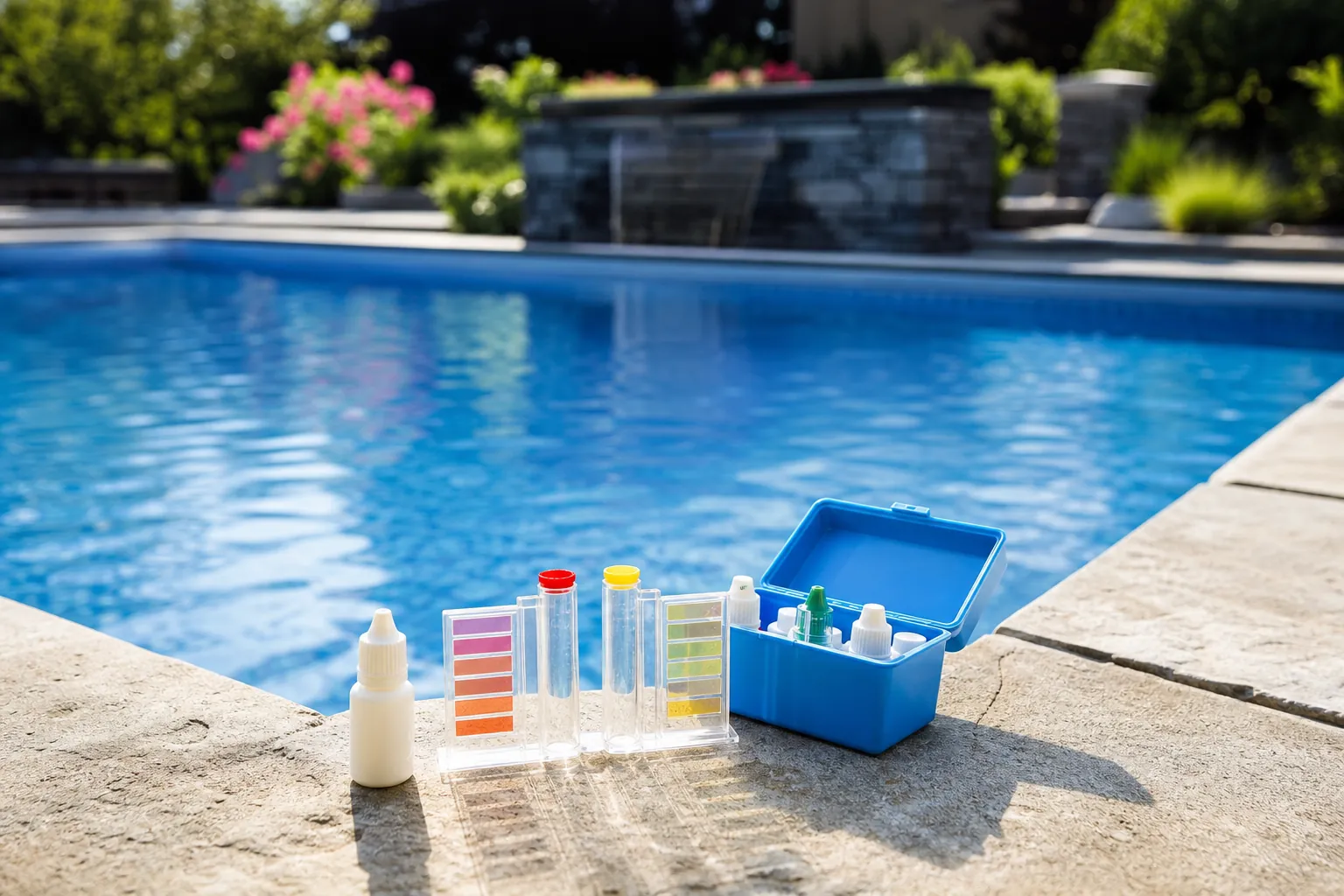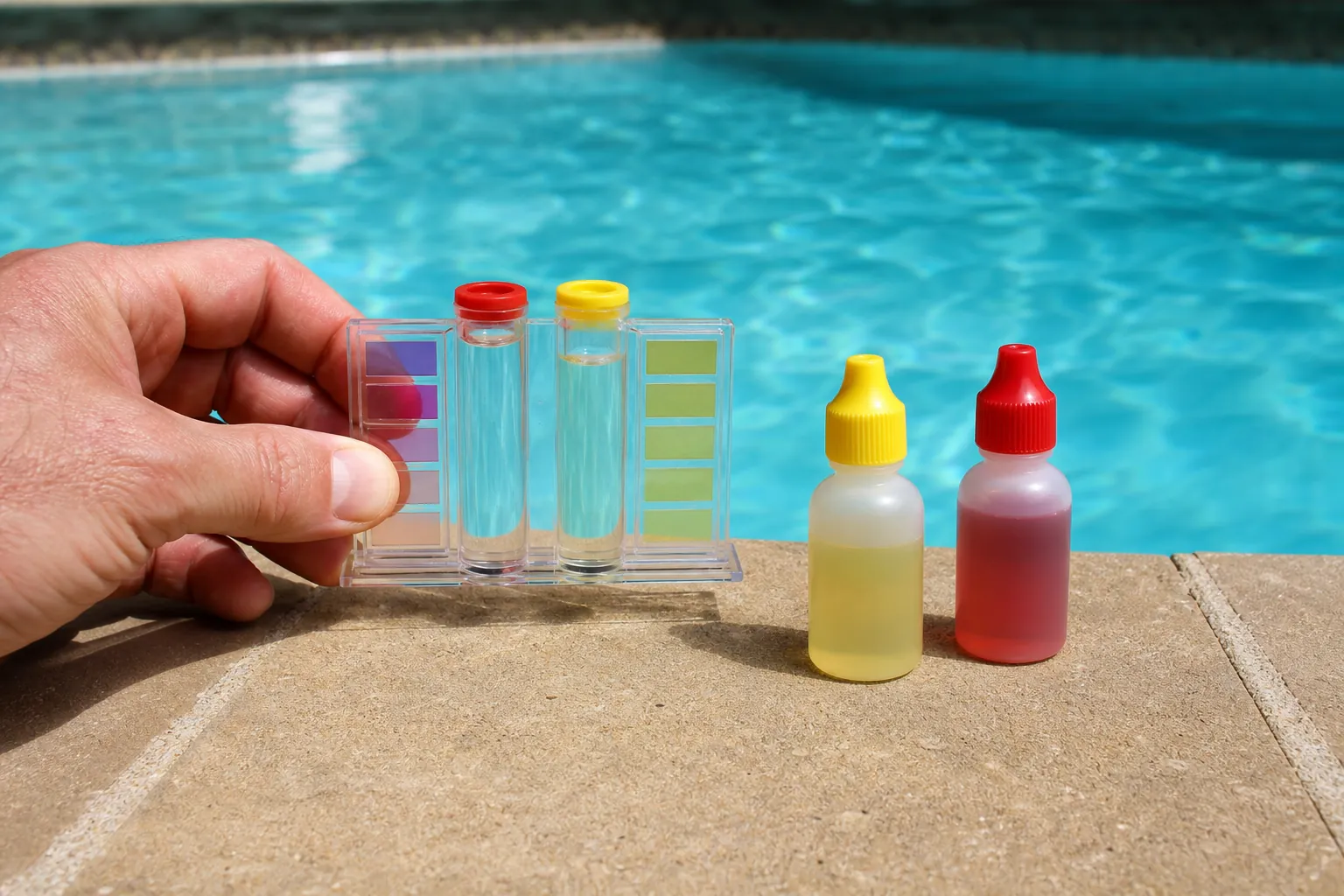
Free chlorine is the pool number people see all the time and still misunderstand. A test strip may show free chlorine, total chlorine, pH, alkalinity, and stabilizer in one tiny colour chart, then leave you to guess which number actually explains the water. That guesswork is why one pool can smell harsh even when it has chlorine, while another can look clear but still be under-sanitized.
So, what is free chlorine in a pool? It is the chlorine still available to sanitize the water. It has not yet been tied up reacting with swimmer waste, sunscreen, leaves, ammonia, or other contaminants. For day-to-day pool care, free chlorine is usually the chlorine number to check first because it tells you whether the water still has active sanitizer available.
That does not make free chlorine the only number that matters. It is the starting point. A useful chlorine reading always sits beside pH, stabilizer, water clarity, circulation, and what happened in the pool recently. A pool after a quiet cloudy week is not asking the same thing from chlorine as a pool after a hot birthday party, a thunderstorm, and a bunch of sunscreen.
This guide explains free chlorine in plain English, how it differs from combined and total chlorine, what affects the reading, how to test it, and when the number points to a bigger maintenance problem. If your issue is already a high reading, start with Aquastaser's guide to lowering chlorine in pool water safely. If you are still trying to understand the test itself, keep reading.
Free chlorine at a glance
Free chlorine is the active part of a pool chlorine reading. The quick reference below helps turn a test-strip result into the next question worth asking before you add anything to the water.
| Reading | What it means | Check next |
|---|---|---|
| Free chlorine | The chlorine still available to sanitize the water. | Compare it with the operating range for your sanitizer, stabilizer level, and product label. |
| Total chlorine | Free chlorine plus chlorine that has already reacted with contaminants. | Subtract free chlorine to see whether combined chlorine is building up. |
| Combined chlorine | The difference between total chlorine and free chlorine. | Look at pH, swimmer load, debris, circulation, and whether the water smells harsh or feels irritating. |
Free chlorine is the chlorine still ready to work
When chlorine is added to water, part of it becomes the active sanitizer that helps control germs and algae. That available portion is called free chlorine, often shortened to FC. Think of it as the chlorine still ready for duty. It has not been spent yet.
The CDC explains that chlorine and pH are a pool's first defense against germs that can make swimmers sick, and that pool owners need to routinely test and adjust both readings. Its residential pool guidance recommends keeping pH between 7.0 and 7.8, with at least 1 ppm chlorine in pools, or at least 2 ppm when cyanuric acid stabilizer is used. CDC home pool testing guidance
That minimum is not the whole pool-care plan. Residential pools vary by stabilizer level, sun exposure, bather load, water temperature, circulation, and product label instructions. The useful habit is not memorizing one magic number. It is knowing whether the free chlorine in your pool matches the conditions your water is actually dealing with.
A free-chlorine reading also tells you what not to do. If the number is already high, adding more shock or tablets is not careful maintenance. If the number is low, pouring in algaecide without fixing sanitizer, pH, and circulation is usually a detour. Read the number as a clue, not a command.
Free chlorine, combined chlorine, and total chlorine
Pool testing gets confusing because chlorine is measured in more than one form. Free chlorine is the available sanitizer. Combined chlorine is chlorine that has already reacted with contaminants. Total chlorine is free chlorine plus combined chlorine.
Taylor Technologies, a pool and water testing company, explains the three readings this way: free chlorine is the available sanitizer, combined chlorine forms after chlorine reacts with substances such as sweat and sunscreen, and total chlorine is the sum of free and combined chlorine. That is why total chlorine can look fine while the pool still feels off. Taylor's free, combined, and total chlorine guide
The simple math is: combined chlorine equals total chlorine minus free chlorine. If total chlorine is 3 ppm and free chlorine is 3 ppm, combined chlorine is roughly 0 ppm. If total chlorine is 4 ppm and free chlorine is 2.5 ppm, combined chlorine is about 1.5 ppm. That difference matters because combined chlorine is often linked with stale pool smell, irritation, and water that needs attention.
This is why a single chlorine number can mislead people. A basic yellow OTO test can tell you chlorine is present, but it does not explain how much of that chlorine is still free and how much has already reacted. When the pool is behaving normally, that may be enough. When the water smells odd, looks cloudy, or keeps irritating swimmers, separating the readings becomes much more useful.
Why free chlorine can be low even after adding chlorine
Low free chlorine does not always mean you forgot to add tablets. It means the pool is using chlorine faster than the routine is replacing it, or that the test is not capturing the real condition. Heavy swimming, hot weather, rain, leaves, sunscreen, body oils, algae growth, poor circulation, and sunlight can all change chlorine demand.
The CDC notes that pee, poop, sweat, dirt, sunlight, and hot tub jets can reduce chlorine concentration. For backyard pools, the common version is less dramatic but still real: a sunny weekend with lots of swimmers can eat through sanitizer faster than a quiet weekday. A covered, shaded, lightly used pool behaves differently from a full-sun pool full of kids.
Stabilizer also changes the picture. Cyanuric acid helps outdoor pools hold chlorine in sunlight, but too much stabilizer can make chlorine management harder. If you keep adding stabilized chlorine products and the pool starts needing more and more correction, test cyanuric acid instead of only chasing free chlorine.
Low free chlorine can also be a circulation problem in disguise. If water is not moving well through the skimmer, filter, returns, and dead spots, chemicals do not distribute evenly. One test location may look acceptable while another part of the pool is under-treated. Aquastaser's older pool guide gives a simple overview of suction, filtration, and return flow because every pool-care method depends on that path.
Why free chlorine can be high
High free chlorine usually means more chlorine was added than the pool currently needs. That can happen after shocking, after a feeder is set too high, after a salt chlorine generator runs too long, or after tablets keep dissolving while pool use drops. The water may look very clear and still be uncomfortable or unsafe to swim in until the reading comes back down.
Do not use smell as the only clue. A strong pool smell does not automatically mean free chlorine is high. It can also point to combined chlorine and chloramines. That is why comparing free chlorine and total chlorine is more useful than sniffing the air and guessing.
If the free chlorine reading is above your kit's range, treat the pool as too high for swimming and retest carefully. Very high chlorine can also bleach some DPD tests and make the result appear falsely low or even zero, which is another reason to follow test directions instead of reacting to one odd strip.
The fix depends on urgency. If the pool is only slightly high and nobody needs to swim right away, stopping the chlorine feed and letting sunlight work may be enough. If it is far too high, or if a feeder mistake kept adding chlorine for hours, you may need a more deliberate correction. Either way, keep swimmers out until the reading and pH are back where they should be.
pH changes how effective free chlorine feels
Free chlorine does not work in isolation. pH changes how well chlorine does its job and how the water feels on skin and eyes. A pool with enough chlorine on paper can still feel irritating if the pH is out of range.
The CDC says pH between 7.0 and 7.8 best balances germ control, pipe life, and swimmer comfort. It also notes that as pH rises, chlorine's ability to kill germs decreases, especially above 8.0, while very low pH can increase corrosion risk and discomfort. That is the part many quick pool tips skip: chlorine and pH are a pair.
So if free chlorine looks strange, test pH at the same time. If you adjust only chlorine while pH is drifting, you may keep correcting symptoms without fixing the water balance. This is where a better test kit often beats a vague strip reading.
How to test free chlorine without fooling yourself
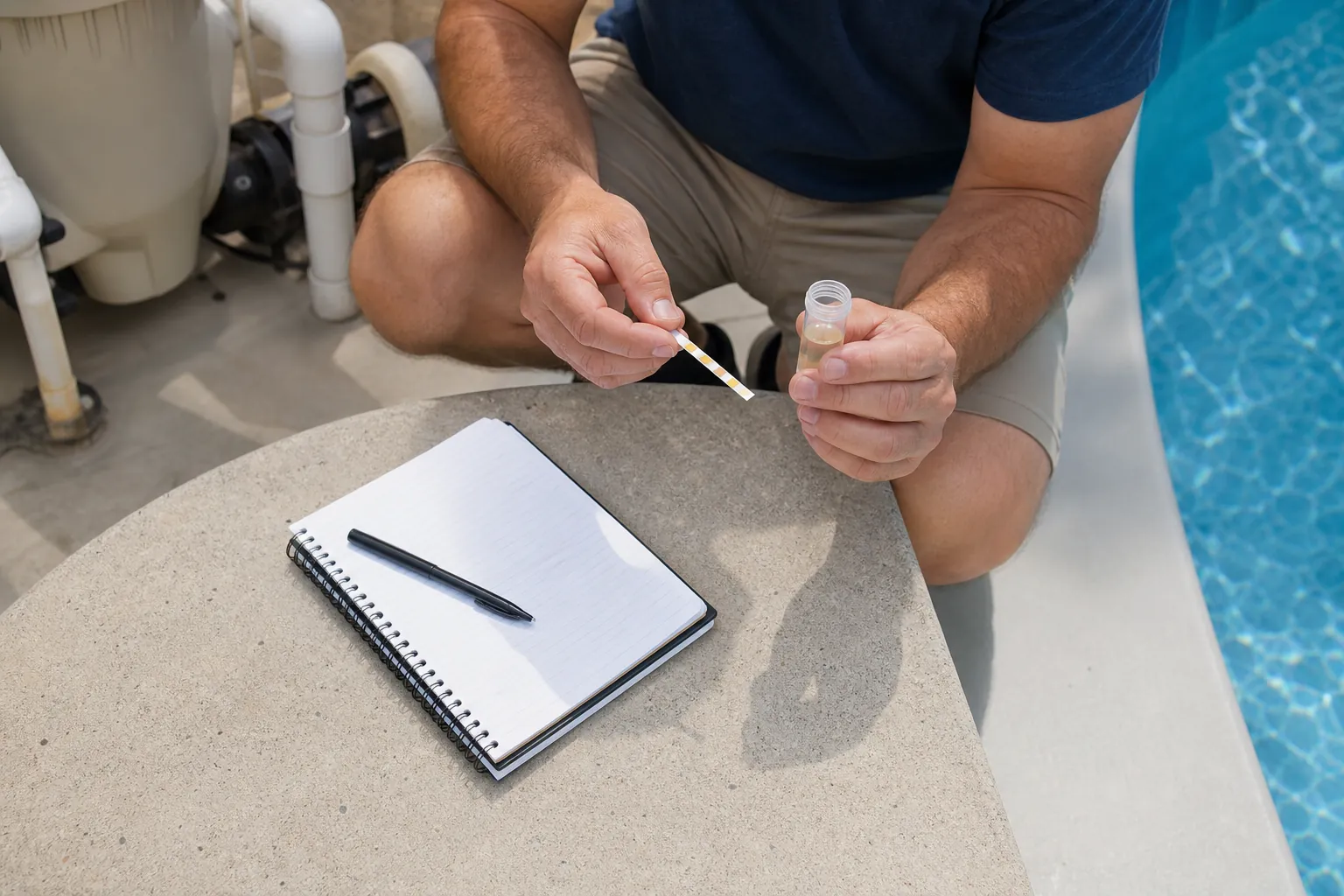
Start with a fresh test kit or fresh strips. Old reagents, sun-baked strips, wet strip containers, and rushed colour matching can produce nonsense. Take the sample from elbow depth, away from return jets, skimmers, and freshly added chemicals. Follow the timing exactly because some readings keep changing if you stare at them too long.
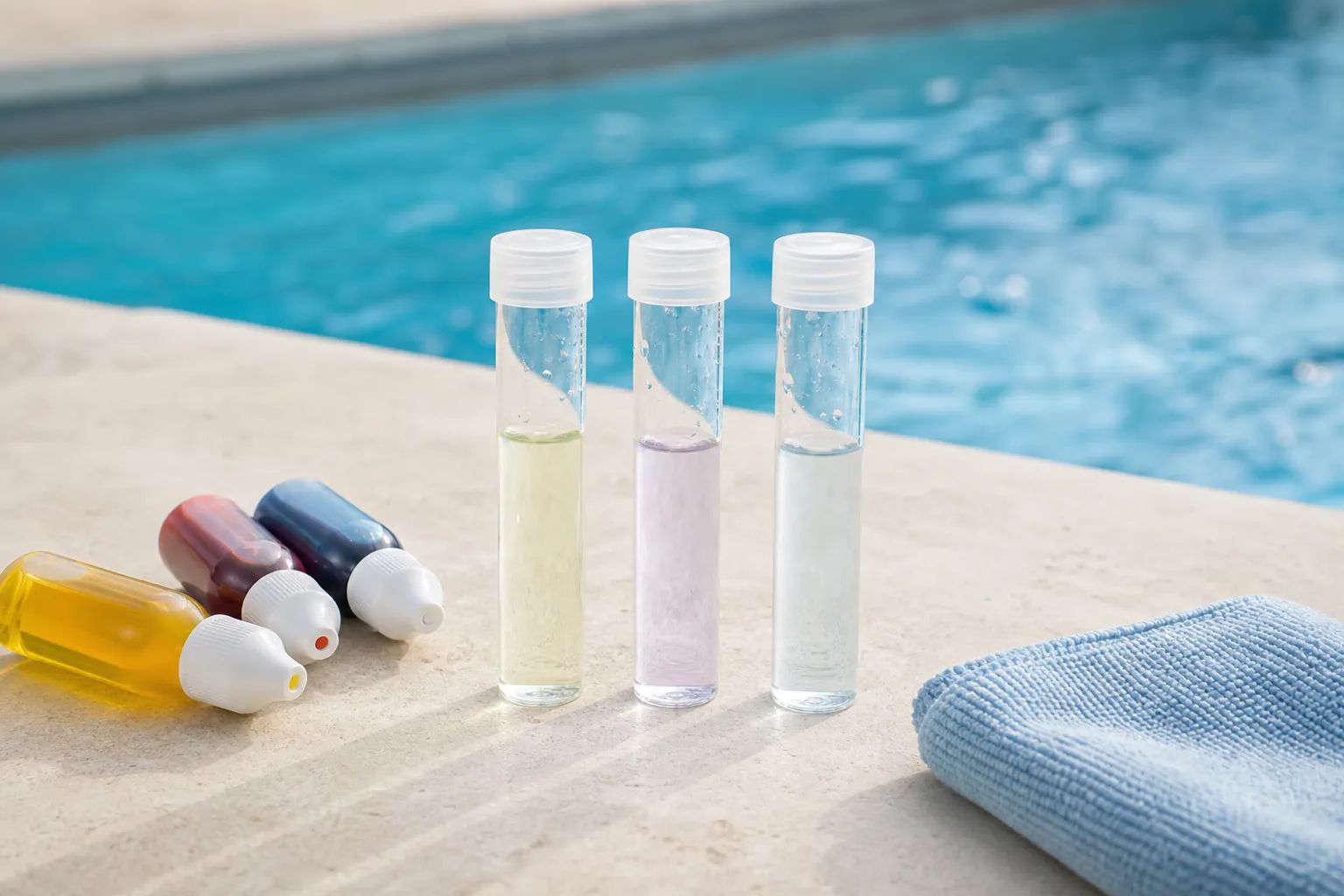
For routine home use, test strips can help you spot trends, but a good DPD or FAS-DPD kit gives more useful detail when the water is confusing. The CDC says DPD kits are more accurate than test strips for measuring chlorine and pH, and it warns that chlorine above 10 ppm can partially or totally bleach a DPD test. That does not make testing impossible; it means the process matters.
Write down the result when you are troubleshooting. Free chlorine, total chlorine, pH, cyanuric acid, water temperature, weather, recent swimmer load, and what you added last are all clues. Without that context, pool care becomes a loop of adding, waiting, retesting, and muttering at a plastic strip.
Retest after the water has had time to circulate. Testing two minutes after adding a product can tell you more about the return jet than the pool. For a normal backyard pool, give the water time to mix, then test again from a consistent spot. Consistency makes trends visible, and trends are usually more helpful than one dramatic reading.
What combined chlorine tells you
Combined chlorine is a warning light, not just another chemistry term. It suggests chlorine has reacted with contaminants and formed chloramine-related byproducts. That can show up as harsh smell, eye irritation, stale-feeling water, or a pool that never feels quite right even though it technically has chlorine.
Chloramine Consulting describes combined chlorine as chlorine that has combined with nitrogen compounds, and gives the same basic equation: combined chlorine equals total available chlorine minus free available chlorine. Chloramine Consulting's combined chlorine explanation
Public and commercial pool guidance often treats combined chlorine seriously because it reflects bather load, ventilation, treatment performance, and water quality. The Pool Water Treatment Advisory Group says combined chlorine should ideally be zero and that higher readings can point to bather pollution, detergents, or treatment problems that need attention. PWTAG technical note on combined chlorine
A quick way to read your chlorine numbers
If free chlorine is low and total chlorine is low, the pool likely needs more available sanitizer or has a demand problem. Check pH, stabilizer, circulation, debris, and recent pool use before simply adding more and walking away.
If free chlorine is low but total chlorine is much higher, combined chlorine is building up. The pool may need oxidation, better circulation, filtration attention, dilution, or a shock process matched to your pool type. Do not assume the water is fine just because total chlorine exists.
If free chlorine is high, stop adding chlorine and wait, expose the water to sunlight, dilute carefully when appropriate, or use a pool-grade neutralizer if speed matters. Aquastaser's high chlorine guide walks through that decision in more detail.
If all the numbers look technically acceptable but the pool still feels harsh, widen the check. Look at pH, combined chlorine, stabilizer, filtration, debris, recent swimmer load, and how often the pump runs. Pool water rarely misbehaves for only one reason. The better question is usually not, "What product should I add?" It is, "Which part of the routine is forcing me to keep correcting this?"
Where Aquastaser fits
Understanding free chlorine is useful even if your real goal is to stop living by chlorine numbers. It helps you see the routine clearly: test, dose, balance pH, watch stabilizer, respond to sunlight, adjust for swimmer load, and repeat. Some pool owners are fine with that. Others want a simpler everyday water-care system.
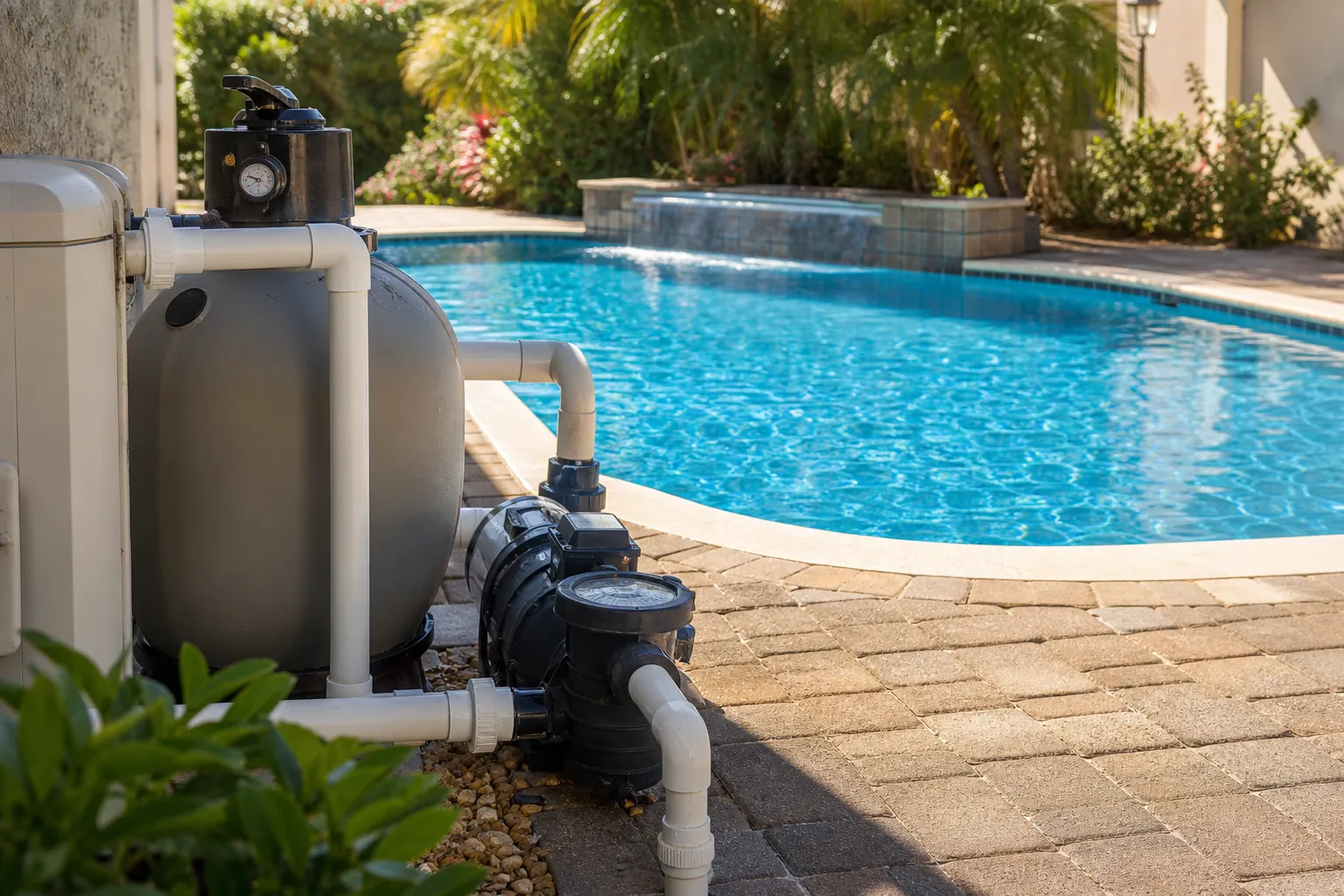
Aquastaser is built for pool owners who want to move away from the traditional chlorine routine. The system uses hydrodynamic cavitation after filtration, so pool fit depends on plumbing, pump flow, circulation, and current water condition. The How It Works page explains the process, and the chlorine-free pool system page explains how it compares with chlorine and saltwater options.
If your pool is currently out of balance, fix the water first. Then decide whether the old routine is still serving you. If you want help checking fit, send your pool size, equipment questions, and current maintenance routine through the contact page before ordering the Aquastaser system.
Frequently asked questions
What does free chlorine mean in a pool?
Free chlorine is the chlorine still available to sanitize the water. It has not yet reacted with contaminants, so it is the reading most pool owners should check first when deciding whether the water has active sanitizer available.
Is free chlorine the same as total chlorine?
No. Total chlorine is free chlorine plus combined chlorine. If total chlorine is higher than free chlorine, the difference is combined chlorine, which can point to chloramines and water that needs attention.
Why is my free chlorine low but total chlorine high?
That usually means combined chlorine has built up. Chlorine has reacted with contaminants, but there is not enough available free chlorine doing the work you want. Check pH, circulation, swimmer load, debris, and whether the pool needs a proper shock or other correction.
Can you swim with low free chlorine?
Do not swim just because the water looks clear. If free chlorine is below the safe operating range for your pool and sanitizer type, the water may not have enough active sanitizer available. Retest, balance the water, and follow your product label or pool professional guidance.
Does a saltwater pool have free chlorine?
Yes. Saltwater pools generate chlorine from salt, so they still rely on free chlorine as the active sanitizer. Saltwater can change how chlorine is produced and maintained, but it is not the same as a chlorine-free pool.