A high total-alkalinity result can make pool care feel stubborn. You lower pH, then it rises again. The water may start leaving scale, the test colors keep changing, and every new bottle promises a quick fix. The sensible response is not to throw a large dose of acid at the pool. It is to confirm the result, understand what the other readings are telling you, and make one measured change at a time.
Total alkalinity helps buffer pH, which is useful until the buffer is so high that pH becomes difficult to move and keep in range. Lowering alkalinity usually involves an acid product, but the right approach depends on your pool volume, surface, current pH, product directions, and equipment. This guide explains the homeowner decision process without pretending there is one safe dose for every pool.
If the pool is cloudy, green, strongly odorous, causing burning eyes or persistent irritation, or has a circulation problem, pause swimming and deal with those immediate issues first. A water-balance adjustment cannot repair a failing pump, clear an illness concern, or make a chemical-mixing mistake safe.
What high total alkalinity means
Total alkalinity is the water's ability to resist sudden pH change. It is connected to pH, but it is not the same number. When alkalinity is high, pH can resist a normal correction and then drift upward again. That can make ordinary pool care feel like a loop because you are correcting the visible pH number without addressing what is helping it rebound.
Many residential pool references use 80 to 120 parts per million as a typical total-alkalinity checkpoint. The FROG total-alkalinity guide also notes that the best range can vary with the pool's system. Your surface, source water, sanitizer, equipment, and product instructions matter, so a reading just above a generic range is not automatically a reason for a dramatic correction.
High alkalinity can contribute to pH that keeps rising, cloudy-looking water, and scale on surfaces or equipment. Those signs can have other causes too. Look at the complete test and the pool's recent history before assuming the alkalinity number is the only problem.
Confirm the reading before treating it
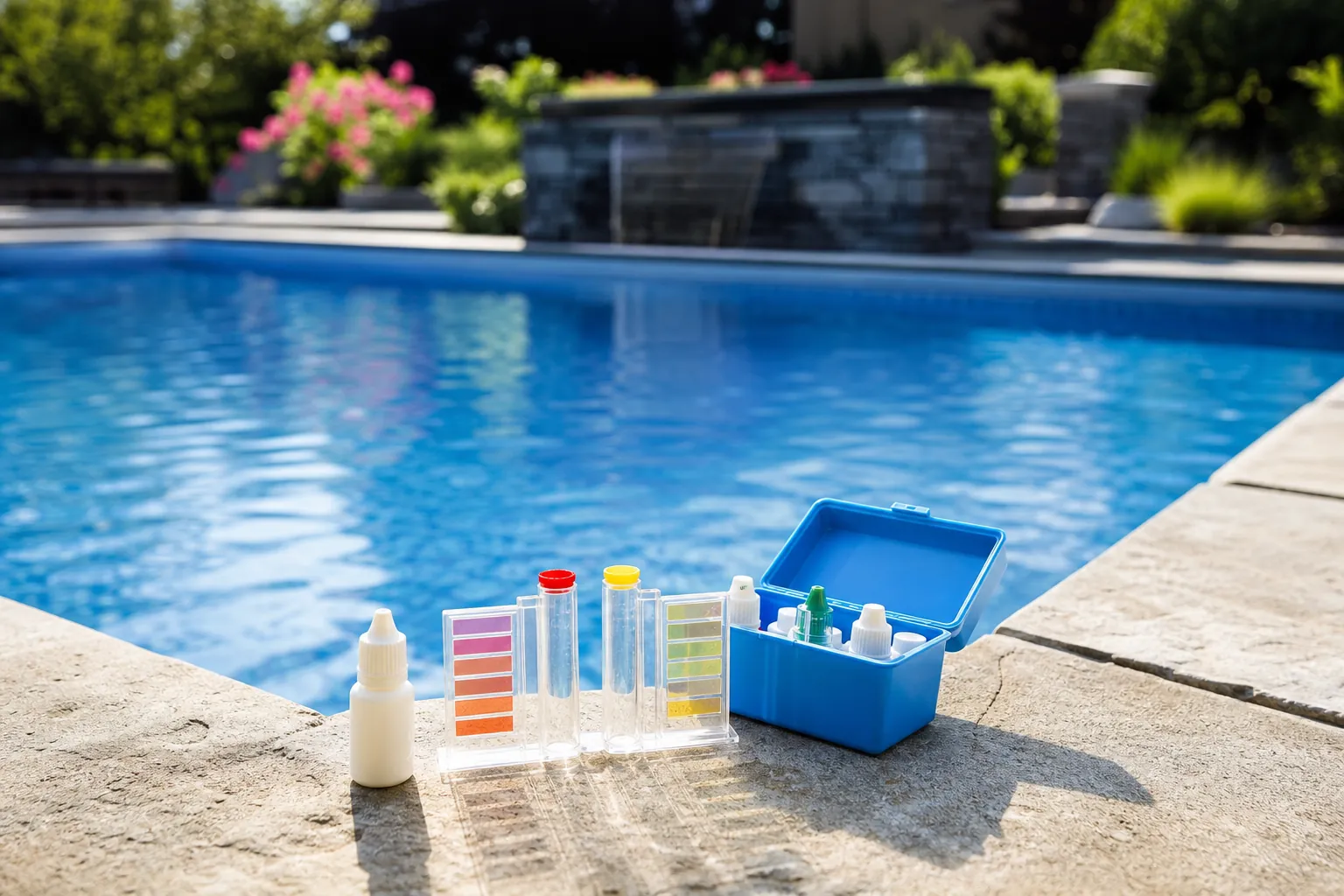
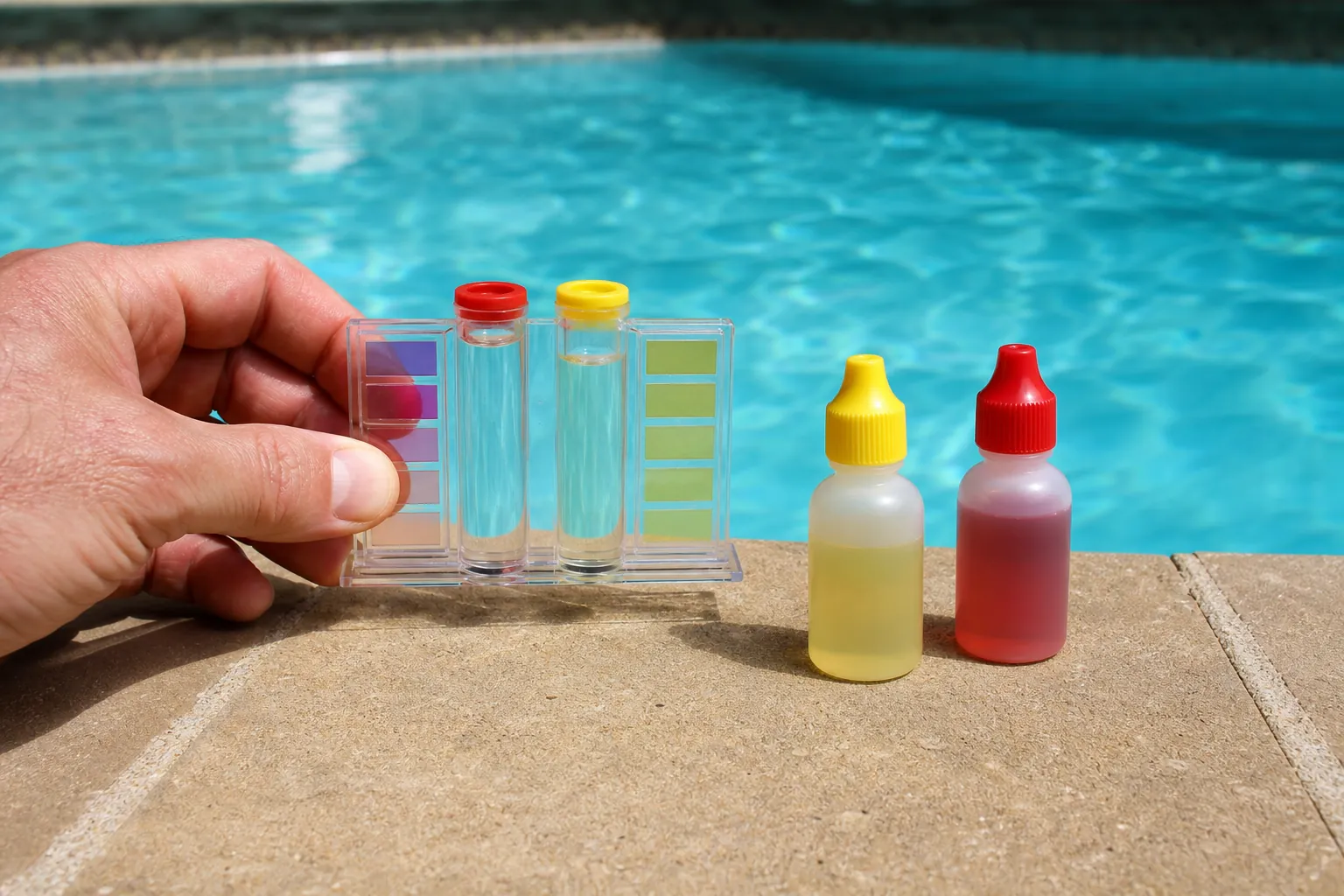
Start with a fresh sample from elbow depth, away from the skimmer, return jets, tablet feeder, or salt cell. Follow your test kit's timing and color instructions exactly. If the result surprises you, repeat the test before adding anything. A stale strip, a poor sample, or a rushed reading can turn a small problem into several unnecessary corrections.
Test pH at the same time and write both numbers down. The CDC's home-pool guidance recommends keeping pH between 7.0 and 7.8 because pH affects swimmer comfort, equipment, and how well chlorine works. The guidance is useful context, but product labels and qualified local advice should control the exact chemical handling for your pool.
If a chlorine result is part of the confusion, Aquastaser's free chlorine guide explains what the active chlorine reading means. A complete baseline gives you a much better next step than trying to correct one color on a strip.

Decide whether the pool needs action today
Look for a pattern, not just one high number. Has pH been rising after careful corrections? Are you seeing recurring scale near the waterline, on the salt cell, or around return fittings? Did the reading follow a refill, a stretch of hot weather, a lot of aeration, or several additions made close together? Those details help you separate a temporary shift from a real water-balance issue.
A short record can make that pattern visible. Note the date, total alkalinity, pH, free chlorine, whether the pool was topped off, and what was added. The next result is much more useful when it has context. It also makes a qualified conversation easier if you need help.
If alkalinity is only slightly high and pH is already in range, do not rush to force the number down. The better decision may be to keep testing, let normal pool use and circulation continue, and make changes only when the product directions or a qualified pool professional support them. Overcorrecting is how a manageable high reading becomes low pH, corrosive water, or another long weekend of chasing test colors.
If you are also dealing with high pH, read the guide to lowering pool pH safely. The two issues are related, but a pH correction and a long-term alkalinity adjustment are not automatically the same job.
1. Use only a pool-specific acid product
Pool owners commonly use an acid product to lower alkalinity, often muriatic acid or dry acid. Those products are not interchangeable, and the concentration, handling directions, and amount for a particular pool can differ. Use a product intended for pool water and follow the current label for your actual gallonage and starting readings.
Before you begin, clear the work area and read the label from start to finish. Keep the product upright, avoid working alone if you are unfamiliar with the container, and do not leave the lid or measuring tools within reach of anyone using the pool. These small precautions are practical because pool chemicals deserve the same attention as any other household product with handling warnings.
The practical rule is to measure for the pool you have, not a generic pool on the internet. A small plunge pool and a large in-ground pool react very differently to the same amount. If you do not know the pool volume, check the build paperwork, use a reliable volume calculation, or ask a pool professional before you dose.
Acid products demand basic care. Keep containers closed and dry, use the protective equipment listed on the label, work in a ventilated outdoor area, and keep children and pets away while you prepare. Never mix pool chemicals together, never combine products in a bucket, and never assume that a household cleaning acid is a substitute for a pool product.

2. Lower in small, labeled increments
Use the product label to calculate a conservative first increment for the pool volume and current test. A smaller adjustment gives you information. A large adjustment gives you a harder problem to unwind. The goal is stable water, not the fastest possible drop in one afternoon.
Keep the pump running normally and follow the label's application method. Do not pour product into the skimmer unless the manufacturer specifically instructs you to do so. Do not add acid, shock, clarifier, algaecide, and another pH product in the same session. Once several chemicals enter the pool together, it becomes much harder to know what changed the water.
If the pH begins near the low end of its suitable range, stop and get specific advice before trying to lower alkalinity on your own. Acid lowers pH as well as alkalinity. A one-size-fits-all routine can push the water into a range that is uncomfortable for swimmers and harder on equipment.
3. Let circulation do its job, then retest
Give the water time to distribute the adjustment according to the product label, then retest with a fresh sample. Check total alkalinity and pH together. Do not judge the result beside the return jet or moments after adding a product, because that sample may not represent the whole pool.
Circulation matters because it moves the correction through the water and past the filter. Check that return flow looks normal, baskets are clear, the pump is primed, and filter pressure is not telling you that the system needs attention. Aquastaser's pool circulation guide can help you identify the equipment that needs to be working before water chemistry can settle.
While the pump runs, look for small practical changes that can influence a reading: a clogged skimmer basket, a dirty filter, a low water level, or a return jet that has lost its normal push. Correcting those basics will not solve every high-alkalinity result, but it keeps a chemistry adjustment from carrying the whole burden when the system also needs attention.
If the reading improves but is not perfect, resist the urge to repeat the full dose. Compare the new result with the old one, allow the full label-directed interval, and make only the next correction that is actually needed.

Why pH may rise again while alkalinity is high
High alkalinity can make pH unusually resistant to change. After an acid correction, pH may rise again because normal water movement, return jets, waterfalls, spa spillovers, and other aeration can release carbon dioxide. That does not mean you failed or that the right response is an immediate second dose.
Give ordinary water movement a chance to settle before treating it as failure. Splashing, fountains, spa spillovers, and a strong return pattern can all change what the next test looks like. That is why a fresh, well-circulated sample and a simple record matter more than checking the same water every few minutes.
Some pool-care methods deliberately use a sequence of careful acid additions and controlled aeration to lower total alkalinity over time while keeping pH from staying too low. That is a more technical process than a basic pH correction. It depends on the pool's readings, surface, equipment, and the exact product directions, so it is sensible to use a qualified pool professional when the pattern is persistent or the method is unfamiliar.
Saltwater pools need the same care. A salt chlorine generator still produces chlorine, and the pool still needs attention to pH, alkalinity, flow, filtration, and scale. Aquastaser's saltwater versus chlorine comparison explains why the delivery method changes without eliminating the water-balance work.
What not to do with high alkalinity
Do not treat a single high strip result as a reason to drain the pool, add a large amount of acid, or make several corrections back to back. Confirm the test and review pH before you touch the water. Slow work is not indecision here. It is how you avoid a sharp swing in the other direction.
Do not mix products, pour chemicals into one another's containers, or reuse a measuring cup for different chemicals without following the product safety directions. The Orenda guidance on lowering alkalinity also emphasizes that this is a gradual process, not a single aggressive treatment.
Do not blame alkalinity for every cloudy pool, harsh smell, or swimmer symptom. A strong chlorine smell can point to combined chlorine, while cloudy water may involve filtration, particles, algae, or circulation. Use Aquastaser's chloramines guide and high-chlorine guide when those are the actual problems.
When to pause and call a pool professional
Get qualified help when pH keeps climbing after careful adjustments, alkalinity remains high despite label-directed treatment, scale keeps returning, or you are unsure how to calculate a safe amount. A professional can test beyond one strip, confirm pool volume, inspect source water, and look for equipment or surface conditions that are keeping the pool out of balance.
Pause swimming and seek timely advice if the water is cloudy, green, strongly odorous, causing burning eyes or persistent skin irritation, or if there is an electrical, pump, plumbing, or chemical-mixing concern. A diarrheal incident is different from ordinary maintenance. Aquastaser's Cryptosporidium guide explains why a pool contamination concern needs a more careful response before anyone returns to the water.
Bring the recent test results, product names, pool size, and a short note about what changed. That gives a professional something useful to work with and reduces the chance of receiving another generic guess.
Where Aquastaser fits after the water is stable
Lowering alkalinity is a normal pool-care task, not a reason to replace equipment overnight. First stabilize the water, resolve active equipment problems, and make sure the pool is safe to use. Those basics matter with any pool system.
If the larger pattern is what has become exhausting, repeated chemical purchases, constant test corrections, and uncertainty about the next swim, it may be time to consider a different long-term approach. Aquastaser is a chlorine-free system installed after filtration in the return plumbing. It still needs healthy circulation, a functioning filter, and a real fit check for your pool.
Read how Aquastaser works and the chlorine-free pool system overview when you are comparing options. For a practical conversation about pool size, plumbing, pump flow, and current water condition, contact Aquastaser through the support page before ordering.
The bottom line
To lower alkalinity in a pool safely, confirm the reading, test pH at the same time, use a pool-specific acid product exactly as labeled for your pool volume, circulate the water, and retest before making another adjustment.
High alkalinity often improves gradually. That patience protects the pool, the people using it, and your equipment from the much more expensive problem of overcorrecting.
Frequently asked questions
What should total alkalinity be in a pool?
Many residential pool references use 80 to 120 ppm as a typical checkpoint, but the right range can vary by pool surface, sanitizer, source water, equipment, and product directions. Use your full test results and the directions for your own pool products.
What lowers total alkalinity in a pool?
Pool owners commonly use an acid product intended for pool water, such as a labeled muriatic acid or dry acid product. The right amount and handling depend on the product, pool volume, current pH, total alkalinity, and pool surface, so follow the label rather than a generic dose.
Will lowering alkalinity lower pH?
Yes. Acid products can lower both total alkalinity and pH. Test both readings before and after the adjustment, make a conservative labeled correction, circulate the water, and retest before deciding on another dose.
How quickly can I lower pool alkalinity?
It is usually a gradual process. The time depends on the starting readings, pool volume, product directions, circulation, water features, and whether pH also needs attention. Avoid repeating large treatments before the water has circulated and you have retested.
Can I swim after lowering pool alkalinity?
Follow the exact product label. Keep swimmers out while you make the adjustment and until the water has circulated for the stated time and a fresh test confirms the pool is back in its appropriate operating range. Get qualified advice when the water is cloudy, harsh, causing symptoms, or the result is unclear.